
The invisible designer
Historically, product design has been understood like this:
A designer creates the object.
A craftsperson makes it.
A repairer maintains it.
That hierarchy has existed for centuries.
The perfect repair should disappear into the original. Whether it’s a museum conservator restoring a painting or a cobbler repairing shoes, success is usually measured by faithfully the return the object to its previous state.
However, in my studio, I see every restored object has two designers. One creates its beginning. The other design its new meaning. I am not replacing Gucci or Hermès, I intervene at a different moment in the object’s life journey.

A restored rare vintage Gucci Jackie I spent some hours with.
Let’s imagine three examples.
Case 1
A cracked leather handles is replaced with an identical leather handle.
No new meaning.
Repair.
Case 2
The handle is rebuilt using a stronger construction because the original failed.
New function.
Repair + engineering.
Case 3
The damaged panel becomes embroidered textile inspired by Chinese craft traditions.
The object now communicates something I never communicated before.
That is design.
Repair becomes design the moment when it is not trying to restore the past, rather creates new
Meaning.
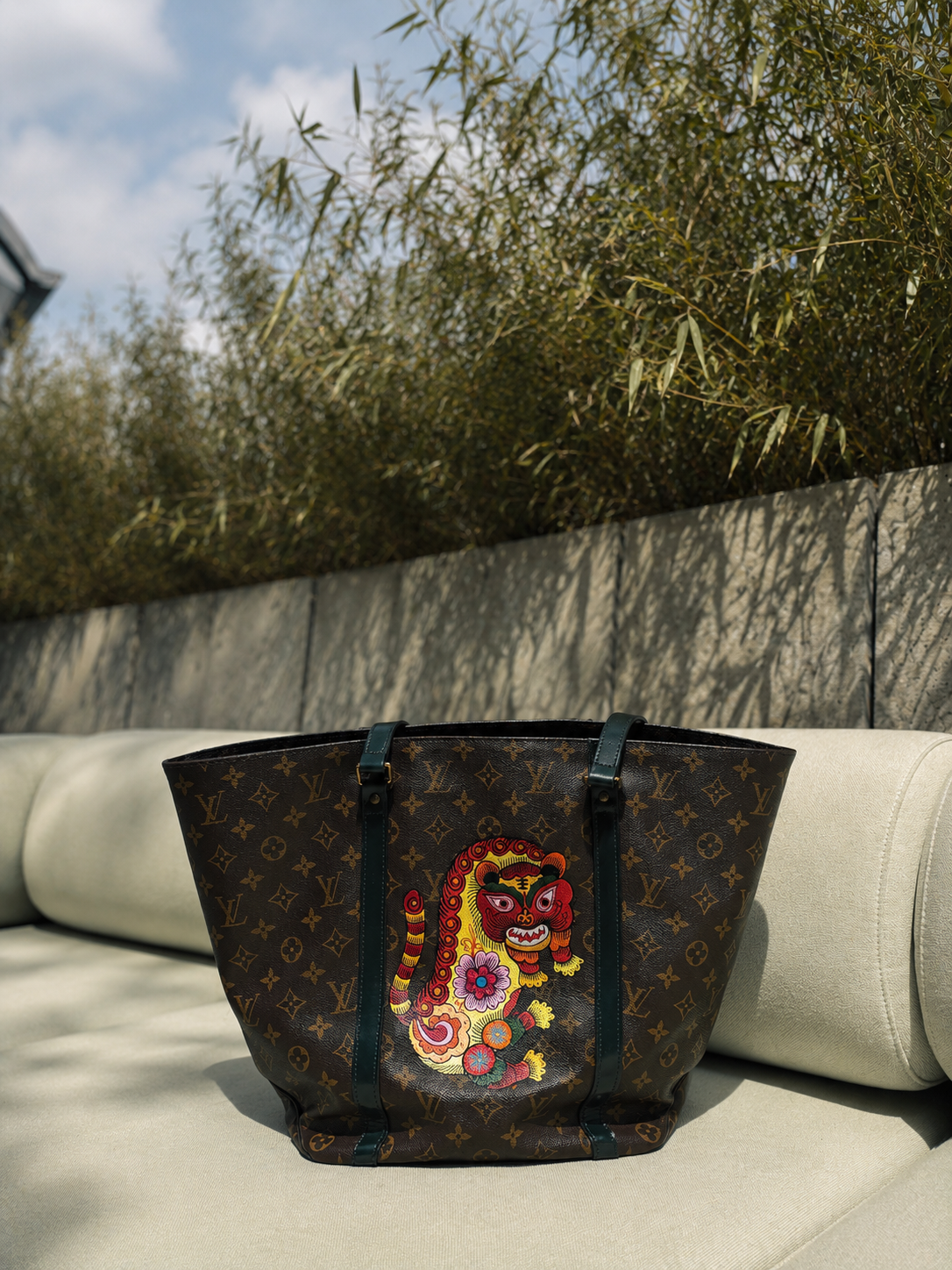
A Louis Vuitton designed to showcase a beautiful “cultural marriage” on its damaged canvas body.
Perhaps the second designer is the one whose name never appears anywhere on the object, but someone leaving a long-lasting impact on an object’s life.
This is the true meaning of my practice.